

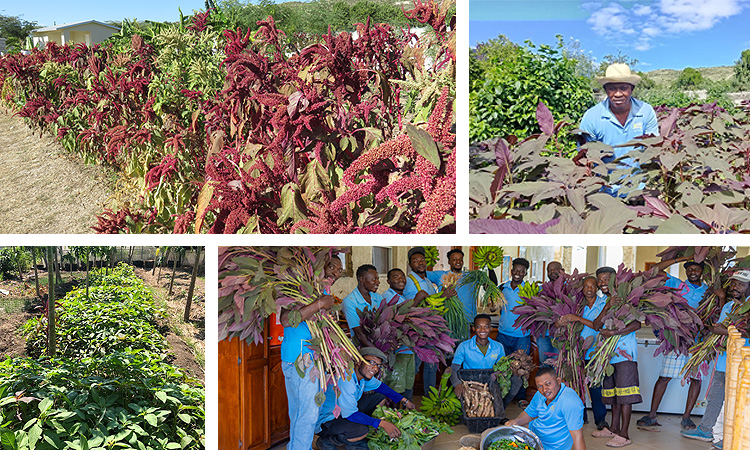
We often mention the extreme nutrition of the Moringa trees, but a close second, “most nutritious” plant that we feature is the Amaranth plant. We use the Midnight Red variety of Amaranth that is specially selected by Hope Seeds International for its hearty properties of growing well in Haiti and being packed with nutrition. The Haitians love their “Epinard” (Amaranth “spinach”) for its ease of growing, good taste, and wide variety of uses in the kitchen. The young plants (20-30 days from sowing seed) give tender leaves for eating fresh as a garnish or salad, and the mature plants (30-60 days) have abundant leaves to be cooked like our spinach. 90-120 day plants also yield abundant seeds that can be cooked as a tasty, nutty-flavored grain like Quinoa or ground into a flour. Heirloom gardens in the U.S. use Amaranth instead of common spinach, like “Bloomsdale,” because it yields so many more leaves and does not bolt to seed as fast as common spinach. Amaranth has Vitamins (A, B, C); Minerals (Zinc, Iron, Copper, Calcium, Magnesium, etc.); antioxidants; and even complete (9 amino acids) gluten-free protein. It has 3 times as much Calcium as common spinach, which we normally grow in U.S. gardens. Amaranth is a very popular way for Haitians to enjoy fiber-rich nutrition with ease because it grows fast, re-sows itself from its thousands of seeds per plant, and acts like a perennial even though it really is just an annual. In Haiti, they can grow it all year long and can often get 5-6 crops per year. It’s easy to see why our harvest pictures almost always have large bundles of their “spinach” (Amaranth). We thank Wilner and his skilled ATC team, and all of you who support our “Development for Sustainability” programs, and we especially thank Dave Balsbaugh and his family at Hope Seeds International for their critical donations of specially selected seeds that help feed hungry souls around the world.
Rad Hazelip, Assistant Executive Director