

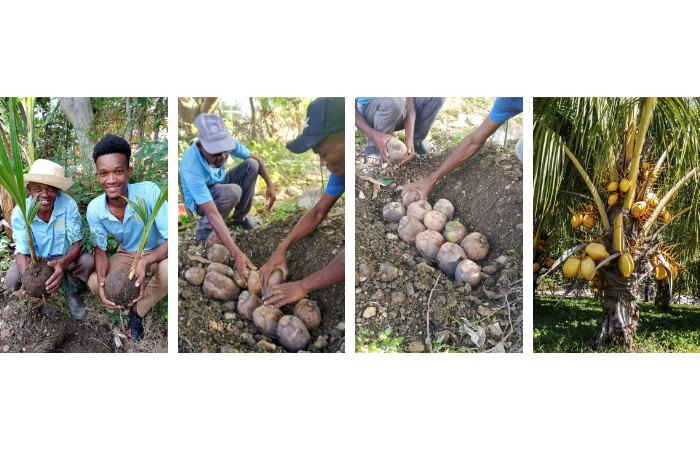
About this time last year, we wrote about our Coconut Tree Project, where we were using the improved coconut variety, Kerasree “dwarf” coconuts, because of their resistance to parasites that had depleted coconuts throughout Haiti in the early 2000s.
Before the parasite outbreak, growing and selling coconuts was an easy business for many Haitians who relied upon their coconut crop to provide money for their families and to send their children to school.
Wilner and the Agricultural Training Center (ATC) staff started a coconut tree project for us about 5 years ago by buying 125 coconut “seeds” (small, young coconuts for sprouting rather than for eating) with money provided by a donor who regularly supports our sustainability programs.
Now we are harvesting “coconut seeds” from the first trees we planted 5 years ago. This week, Wilner and the ATC staff prepared 12 “seeds” for germinating.
Among these pictures, you see the “coconut seeds” being put into a shallow trough they had dug. They will partially bury the coconut seeds in the trough and put straw and mulch on top to keep them moist for 30 days, long enough for them to sprout. Once they sprout, the new coconut seedlings will be planted around Love A Child and the surrounding community to provide many good coconuts for the next 80 years.
Our new coconut project provides the basis for many new coconut farmers to have a sustainable income. Donors whose gifts support our sustainability projects give a gift that continues giving for generations to come. This coconut tree project is part of our “edible plant nursery,” where we demonstrate how to provide food and income from edible plants.
Food for a lifetime.
Rad Hazelip, Assistant Executive Director