

Many studies over the years show that deep, cyclical poverty is rooted in a lack of basic resources, like water, food, and shelter. Lack of resources is often exacerbated by poor community and governmental structures. Haiti is a good example of all of this, lacking clean drinking water, fertile lands for crops, poor housing, and virtually non-existent national or local governments.
Haiti’s lack of resources begins with its depleted forests. Haiti used to have abundant trees, but back during the colonial period, trees were being cut down to make way for coffee, sugar, and fruit plantations. The large-scale deforestation, along with other poor agricultural practices, exhausted soil nutrients and led to rapid erosion. Today, deforestation continues due to the overreliance on trees for cooking fuel. Haitians have always burned wood charcoal for cooking, and the demand for charcoal has doubled over the last two decades, compounding the rate of deforestation.
With every family constantly needing charcoal, charcoal production became a “job” that almost anyone could have. Therefore, everyone scrounges for any wood that can be made into charcoal, either to sell or to use.
For many Haitian families, this is their only source of income. Many of Haiti’s children in the rural areas are the ones who must get up early every day and search for wood that can be made into charcoal. They cannot even go to school, as their labor may be the only source of income for the family, which usually amounts to less than a dollar a day, not even enough to get a little bit of food for a starving family to eat that day.
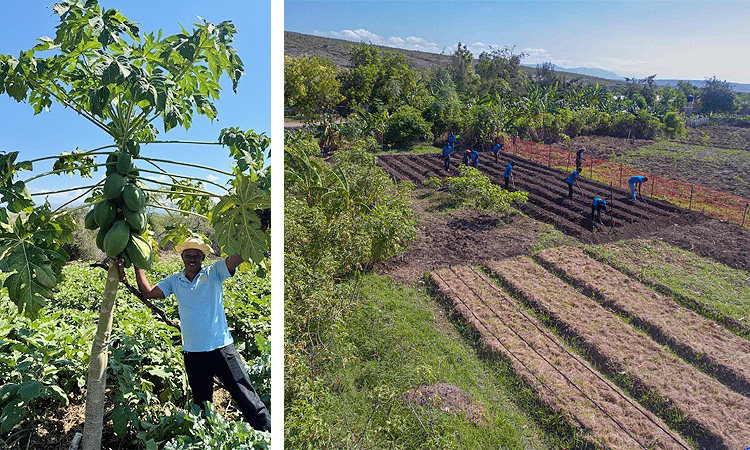
At our Agricultural Training Center (ATC), we teach the importance of regenerating the land through growing more trees. We have had some successful tree planting projects over the years, but we are learning new methods of “reforestation” without planting trees.
Recent projects are demonstrating that you can harvest rainwater and control erosion by using simple, low-tech, low-cost techniques to slow the seasonal rainwater run-off, spread it out over a wider area, and let it sink into the ground. These methods increase available groundwater that allows trees and vegetation to spring up naturally. We are planning a project to demonstrate 4 low-tech, low-cost methods to “slow it, spread it and sink it” to capture the scarce seasonal rainfall and control erosion.
Your support of our Sustainability Outreach helps us help Haitians for generations to come.
Happy Easter and God Bless you.
Rad Hazelip, Assistant Executive Director